The Voynich manuscript – early research
The first post in this series introduced the Voynich manuscript as an object: a fifteenth-century book on calfskin, its pages full of drawings and of fluent writing in a script nobody can read. This post and the next are about the people who have tried to read it.
This one follows the ideas. Over three and a half centuries the book has been taken for a secret treatise by a medieval friar, a cipher, shorthand, a lost natural language, an invented one, and a hoax, and each idea brought its own way of attacking the text. The next post takes up the same story from the 1970s on, when the main tool became counting rather than reading, and looks at the computational methods in detail.
It goes in this order:
- A map of the field: a citation graph of Voynich research, the five kinds of work it is sorted into, and how to read it.
- The first readers, in seventeenth-century Prague and Rome.
- Roger Bacon’s cipher: the first decipherment, and the first demolition.
- The codebreakers: Friedman, Tiltman, Currier and D’Imperio.
- The claimants: half a century of readings, from Cathar liturgy to Proto-Romance.
- What was settled: the results nobody now disputes.
- How readings fail: the pattern every failed claim shares.
- The search space: the concepts of what the book is, laid out side by side, with what each predicts. This is the most important section of the post, because it says where to look.
- What remains open: the questions a century has not answered.
A map of the field
Which studies of the manuscript does the field actually stand on? Searching for “Voynich” returns thousands of items, most of them claims of a solution and a growing number of them written by language models. The graph below is built the other way round, from what the field itself cites. The reference lists of the serious studies were pooled to find the works the field builds on, the newest results, too recent to have been cited yet, were added, and each was checked against the bibliographic databases. I compiled the graph for this post; it is not a published dataset. That gives a canon of 69 works, from Newbold’s book of 1928 to papers published this autumn, and 329 citations between them, found partly in the OpenAlex index and mostly by reading the reference sections of the papers themselves.
Five kinds of work
Before the picture, the classification it rests on, because it is the most important thing in it. Every work in the canon makes one main kind of contribution, and there turn out to be five kinds. Each answers a different question and rests on a different kind of evidence.
- Object (in full: the object, its hands and its order). Studies of the physical book: the radiocarbon dating, the analysis of inks and pigments, multispectral imaging, the palaeography that counts the scribes, the codicology that asks in what order the leaves were written, and the archival work on its owners. What is this thing, when and by whom was it made, and in what order? The evidence is the parchment, the ink and the documents, and it is independent of the text.
- Surveys (surveys and transcriptions). The works that gather what is known and make the text available to others: D’Imperio’s survey, Tiltman’s assessment, Kahn’s history of codebreaking, and the transcriptions, from Friedman’s punched cards to EVA. What has been tried, and what exactly does the page say? They are the field’s memory and its infrastructure. Every statistic depends on a transcription.
- Statistics (statistics and linguistics). Studies that measure the text as it stands and compare it with languages: Currier’s two languages, Bennett’s entropy, Stolfi’s word grammar, Landini’s spectra, and most of the work since. What kind of text is this, judged by its numbers? They do not read the text. They describe it.
- Generators (generators and ciphers). Works that build a procedure, whether a cipher, a grille or a copying rule, that produces Voynich-like text, and then compare its output with the manuscript. Could a process of this kind have produced this text? They test an idea by building it, so that it can fail in public.
- Claims (decipherment claims). Works that say they have read the text, from Newbold to Cheshire. What does it say? They are drawn hollow because nothing has been built on them. Others cite them as cautions, or as hypotheses to test. Manly’s rebuttal of Newbold sits in this lane too, next to the claim it answered.
The five are not arbitrary. They follow the logic of the problem. A reading is a claim about the text. Checking it needs a transcription; judging it needs statistics; deciding whether a text like this needs meaning at all needs generators; and all of them are bounded by what the object itself allows. So the lanes also show how work flows: claims are tested by statistics, statistics are answered by generators, generators are checked by statistics, and the object constrains everything. A few works could sit in two lanes, since Currier counted scribes as well as measuring text, and each was put where its main contribution lies.
Here is the graph.
This figure is drawn in the browser and needs JavaScript.
Ctrl/⌘ + scroll to zoom · drag to pan · double-click to reset
A few things are visible at once. Until the 1970s there is very little: a handful of claims, each answered, if at all, by one rebuttal. Then come the codebreakers’ surveys and, in 1976, Prescott Currier, whose dot grows into the largest in the graph. From the 1990s the statistics lane fills up, and after 2010 the picture becomes a dense web of studies citing each other and, increasingly, citing the generators that try to imitate the text. The claims lane, meanwhile, keeps its hollow dots small. Decipherment claims are cited, when they are cited at all, as warnings.
The graph has its limits. Its dots measure standing within these 69 works, not in the world at large. Some important early works survive only as typescripts or web pages whose references cannot be read, so they appear only as things cited, never as citing anything. And it is a selection, argued for but a selection all the same. As a map of who built on whom, though, it is the one this series uses, and the rest of this post and the next walk through it from left to right. The names in the lanes above all come up there.
The first readers
The first people we know of who tried to read the book were its seventeenth-century owners in Prague. Georg Baresch, an alchemist, owned it by the 1630s. He believed that it held medical knowledge brought back from the East, perhaps by someone who had travelled there to learn it. He spent years trying to read it and got nowhere.
So he wrote to the one man in Europe who seemed equal to the task. Athanasius Kircher, a Jesuit in Rome, had just announced, in a book of 1636, that he could read Egyptian hieroglyphs. He could not, as it turned out when the Rosetta Stone was read two centuries later, but in the 1630s nobody knew that. Around 1637 Baresch sent him a copy of some of the pages. Kircher answered; the answer is lost, but in 1639 Baresch was writing to him again for help.
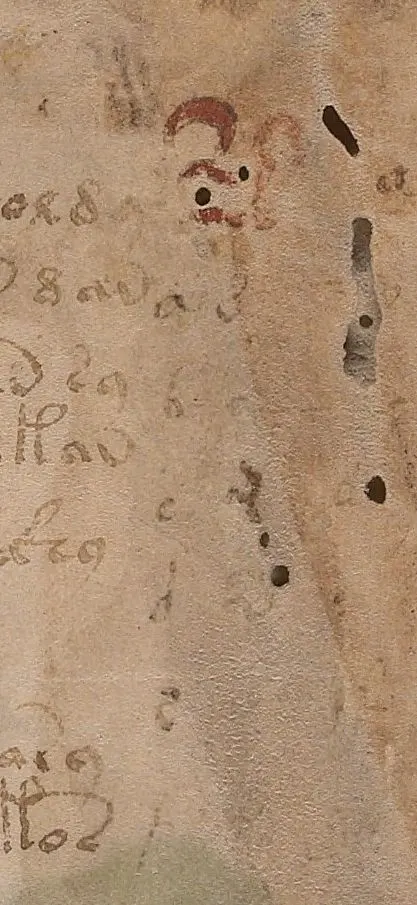
When Baresch died, the book passed to Johannes Marcus Marci, rector of the university in Prague, who sent it on to Kircher in 1665. It is Marci’s covering letter that brought Rudolf II and Roger Bacon into the story, both as hearsay. And it seems that Marci, or someone near him, tried the most direct approach of all. In the margin of the first page, multispectral imaging has revealed a table of three columns: a Latin alphabet, the manuscript’s own letters beside it, and a second Latin alphabet shifted by one place. Lisa Fagin Davis, who published the images, offers two readings: an attempt to read the text with two substitutions side by side, or Marci using the script to make a cipher of his own. If it was an attempt at reading, it is the earliest whose working survives, and the first known to fail.
 (opens the full-size image)
Then the book disappeared into the library of the Collegio Romano for two hundred years.
Roger Bacon’s cipher
When Wilfrid Voynich bought the manuscript in 1912, he took Marci’s hint and ran with it. Roger Bacon was a thirteenth-century Franciscan with a legendary reputation as a scientist and magician, and a book by Bacon in cipher would be worth a fortune. Voynich had photostats made and sent them to anyone who might help: cryptographers, historians, philologists.
The first to claim success was William Romaine Newbold, a professor of philosophy at the University of Pennsylvania. In a lecture of 1921 he announced that the visible letters were a decoy. The real text, he said, lay in tiny marks inside the strokes, visible under magnification: a microscopic Greek shorthand, which, once decoded and put through several further stages of anagramming, revealed Bacon recording discoveries centuries ahead of his time. The claim made newspapers. Newbold died in 1926, and his book, The Cipher of Roger Bacon, was published by a colleague in 1928.1
The answer came in 1931, from John Manly, a medievalist at Chicago who had been a codebreaker during the First World War. He looked at the same marks under the same magnification and found that they were cracks in dried ink. He also showed that Newbold’s procedure, with its stages of anagramming, was so loose that it could produce more or less any text the decoder wanted.2
Manly’s paper is a turning point in the graph, and rightly so. It is the model for every good rebuttal since. He did not argue that Newbold’s reading was implausible, or that Bacon could not have known what Newbold said he knew. He tested the method, and showed that it did not constrain its own output. A method that can produce any text has not produced this one.
Two more readings followed in the 1940s. Joseph Feely took the text to be heavily abbreviated Latin, and Leonell Strong, a cancer researcher, to be a cipher based on a double arithmetic progression, hiding a medical text by an English herbalist, Anthony Askham. Neither method could be made to work by anyone else, on pages the author had not already chosen.3
The codebreakers
Friedman’s study groups
The most famous codebreaker to take on the manuscript was William Friedman, whose Signal Intelligence Service broke the Japanese diplomatic cipher known as Purple. In 1944, when the war had left him with a room full of cryptanalysts and IBM punched-card machines, he set up a study group to work on the book in their spare time. They transcribed the text into a code that could be punched onto cards and sorted by machine. It was the first machine-readable copy of the manuscript, and the start of a line that leads directly to every statistic computed on it today. The transcription was later lost, and was recovered only in 1995.4
The group disbanded when the war ended. Friedman organised a second one in 1962–63, and with his wife Elizebeth, a codebreaker as distinguished as he was, kept coming back to the problem for the rest of his life. Neither group read a word. What Friedman concluded is the most interesting idea to come out of the period. In 1959 he and Elizebeth published a paper on anagram claims in literature and ended it with an anagram of their own: a footnote that read as a remark about anagrams (“I put no trust in anagrammatic acrostic cyphers, for they are of little real value — a waste — and may prove nothing”). Its solution was deposited in a sealed envelope and published only after Friedman’s death, in 1970. Unscrambled, it read that the manuscript was “an early attempt to construct an artificial or universal language of the a priori type”.5
An a priori language is one built from scratch on philosophical principles, not from existing languages. Several were designed in the seventeenth century, in which words are composed from elements that each stand for a category of things. Friedman’s idea was that the regularity he saw in the manuscript’s words was of this kind. It is still open today.
Tiltman
John Tiltman had been one of the best British codebreakers at Bletchley Park and later worked with the American NSA. He looked at the manuscript from 1951 and published his assessment in the NSA’s internal journal in 1967. His most lasting observation was about the shape of words. They behave, he wrote, as if assembled from a small stock of beginnings and a small stock of endings, combined in a regular way. Today that is called slot structure, and much of the modern work on the manuscript’s word grammar starts from it.6
You can see what he meant in any line. Here are six words from folio 2r, each
cut into the parts that recur across the book: a beginning such as qo, ch,
sh or o; a gallows or an o in the middle; and an ending such as aiin,
ey or al.
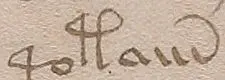
qo · t · aiin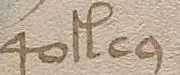
qo · k · ey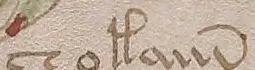
ch · o · k · aiin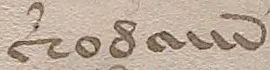
sh · o · d · aiin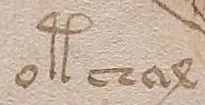
o · t · ch · al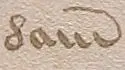
d · aiin
Currier
The single most important contribution of the period came from another NSA cryptanalyst, Prescott Currier, at a seminar in 1976.7 Currier looked at the text page by page and saw that it was not uniform. It split into two populations, which he called languages A and B. Each has its own favourite letters and words: some combinations common in one are rare in the other, and pages in the same stretch of the book share one of them. Currier also saw, from differences in the handwriting, that more than one scribe had been at work, and that the two “languages” went with different hands.
The difference shows in the transcription, and, once you know what to look for, on the page: B is full of words ending in the same few strokes. Here are the opening lines of the book, in language A, and five lines from the bathing section, in language B.
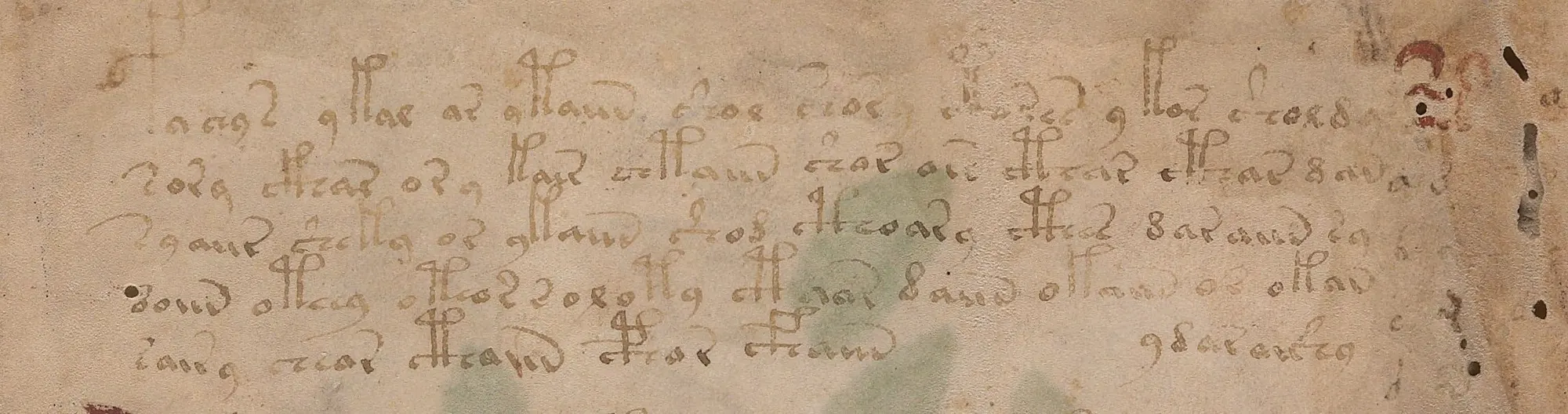 (opens the full-size image)
fachys ykal ar ataiin shol shory cthres y kor sholdy. Words like shol, chol and cthy, and endings in -aiin and -ol, are typical. Beinecke Rare Book & Manuscript Library, Yale University.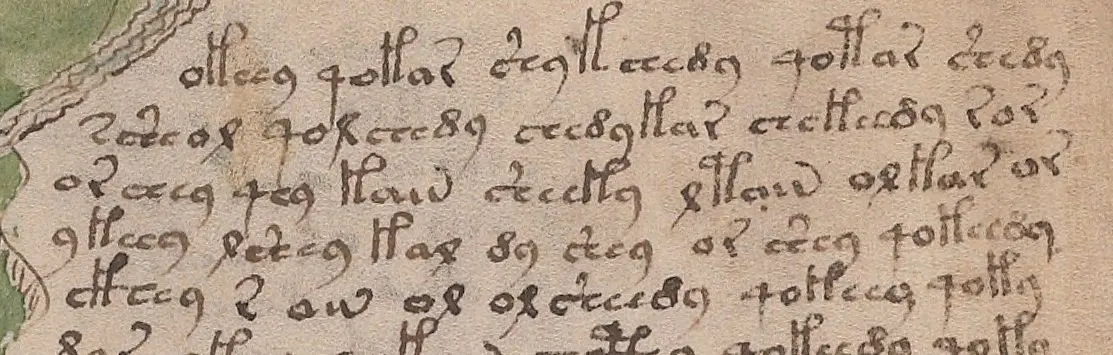 (opens the full-size image)
okeey qokar shyk chedy qotar shedy. Words beginning qok- and ending -edy, such as chedy, shedy and qokeedy, are everywhere in B and rare in A. Beinecke Rare Book & Manuscript Library, Yale University.And he made an observation whose importance has only grown: that “the line is a functional entity”. The first word of a line and the last word behave differently from words in the middle, as if the line itself were a unit of the text and not just where the writing happened to run out of space. In ordinary writing, the end of a line changes the words on it only in small ways, by dividing or abbreviating one at the margin.
He noticed a third thing, in passing: that some word endings are followed by particular word beginnings far more often than chance would allow.
Currier used “language” loosely, for a marked statistical difference between two bodies of text, and said that it “in no way implies the existence of any underlying language”. He spoke of two authors and of two systems of writing, and leaned towards thinking that the text was not a straightforward record of a language. His observations, the two languages, the line as a unit and the link between one word and the next, turned out to be things any later theory has had to account for, which is why he is the largest dot in the graph.
D’Imperio
In 1978 Mary D’Imperio, also of the NSA, published The Voynich Manuscript: An Elegant Enigma, a survey of everything that had been tried and proposed until then.8 It covers the history, the illustrations section by section, every theory and the reasons for doubting it, and it remains the place to start for anyone who wants to know what was known before computers. It was declassified and is now freely available.
By the end of the 1970s, then, the best cryptanalysts of the century had worked on the manuscript and failed to read it. What they left behind was a set of observations: that the words were built from parts, that the text came in two varieties, that lines were units, that the letters were unusually predictable. None of these looked like what a cipher of the period should produce, or like what a natural language written in an ordinary alphabet should produce. They looked like a puzzle.
The claimants
The readings did not stop. They became, if anything, more frequent. Here are the ones the field has thought worth answering, roughly in order; most of them are in the graph.
Brumbaugh, 1975–78. Robert Brumbaugh, a philosopher at Yale, proposed that the book was a forgery made to sell to Rudolf II, with Latin under a two-stage numerical cipher. He also read star maps in it. Nobody could repeat his procedure, and the radiocarbon date, which puts the parchment a century and a half before Rudolf, has made the premise very unlikely: a forger would have needed old blank parchment.
Levitov, 1987. Leo Levitov read the text as the liturgy of the Cathars, the heretics of southern France, written in a Flemish-based creole with loan words from Old French and Old High German. Historians found no trace of such a liturgy, and linguists no trace of such a language.
Tucker and Talbert, 2013; Janick and Tucker, 2018. Arthur Tucker, a botanist, with Rexford Talbert, an information technologist, and later with the horticulturist Jules Janick, saw New World plants in the herbal and proposed that the text was Nahuatl, the language of the Aztecs, from sixteenth-century Mexico. The radiocarbon date is a serious problem for this, since it puts the parchment before Columbus.
Bax, 2014. Stephen Bax, a linguist, proposed readings of about ten words, mostly labels beside plants and stars, which he took to be names. It is the most careful of the reading proposals, and the most modest: he called it provisional, and asked others to extend it. Nobody managed to.
Hauer and Kondrak, 2016. Two computer scientists built a method for identifying the language behind a text written in an unknown script, even when the letters of each word have been scrambled. Its language identification worked well on 380 known languages. Applied to the manuscript, it suggested Hebrew with anagrammed words. The method was sound and interesting, but the reading was not: the “translation” of the first line leaned on Google Translate, and Hebrew specialists did not accept it.
Gibbs, 2017. Nicholas Gibbs proposed in the Times Literary Supplement that the book was a women’s health manual in abbreviated Latin, copied from known medieval sources. Specialists found that his Latin did not make sense, that the parallels he presented as discoveries had long been known, and that his proof rested on two lines.
Ardıç, 2018. Ahmet Ardıç and his family read the text as a phonetic rendering of Old Turkish. It was treated more respectfully than most: Lisa Fagin Davis, the leading palaeographer of the manuscript, called it one of the few solutions she had seen that was consistent and repeatable. It has not been confirmed by anyone else.
Cheshire, 2019. Gerard Cheshire published in a peer-reviewed journal, Romance Studies, the claim that the text was “calligraphic Proto-Romance”, and the University of Bristol, where he was an honorary research associate, announced that he had “succeeded where countless cryptographers, linguistics scholars and computer programs have failed”. Linguists pointed out that Proto-Romance is the reconstructed ancestor of the Romance languages, spoken centuries before any of them was written, and could not be the written language of a fifteenth-century book; and that Cheshire described it in turn as that ancestor and as a Mediterranean lingua franca, which contradict each other. Bristol withdrew its press release within days.9
In the last two years there has been a new wave: readings produced with the help of large language models, deposited by the hundred in open repositories. The next post comes back to those.
What was settled
By 2000, a century of attempts had produced few answers about what the text says, but several results about the book and the text that nobody now disputes. They are worth setting apart, because everything later builds on them.
Settled beyond reasonable doubt:
- No reading has survived. Every decipherment proposed since 1921 has failed independent testing, or never submitted to it.
- Newbold’s hidden writing does not exist. The marks he read are cracks in dried ink (Manly, 1931).
- The book is a genuine medieval object with a documented history from Prague in the 1630s, which disposes of every theory of a modern forgery. The radiocarbon date of 2009 later fixed the parchment to 1404–1438.
- Words are built from parts. A small stock of beginnings, middles and endings, combined in a regular order, makes up nearly every word (Tiltman, 1967, and Stolfi’s grammar of 2000).
- The text comes in two varieties. Currier’s languages A and B differ in their favourite letters and words, and pages in the same stretch of the book share one of them (Currier, 1976).
- The line is a unit. The first and last words of a line behave differently from words in its middle (Currier, 1976).
- Neighbouring words are linked. Certain word endings are followed by certain beginnings far more often than chance would give (noticed by Currier in 1976, measured by Reddy and Knight in 2011, and treated systematically in 2019).
Shown, but argued over then and since:
- Several scribes. Currier saw more than one hand. How many, and whether they match his two languages, is still disputed.
- Not a simple cipher of a European language. The codebreakers suspected it from the start. The measurements that put it beyond doubt came later and belong to the next post.
How readings fail
Looking at the claims together, they fail in remarkably consistent ways. It is worth setting the pattern out, because it is the most useful thing a history of failed decipherments has to teach.
- The key is adjusted to the text. The mapping from signs to letters is changed from passage to passage until something readable comes out, and the readable output is then offered as proof of the mapping. This is circular.
- Words are matched one by one. Individual groups of letters are paired with plausible words, with no account of grammar. Any large enough vocabulary will supply matches.
- Languages are switched. When a word will not fit the proposed language, another one is brought in.
- The method does not repeat. Applied by someone else, or to a page the author did not choose, the procedure yields nothing.
- A few lines stand in for the book. Two lines are translated, and the rest of the book is assumed to follow.
- The structure of the text is ignored. Currier’s two languages, the line as a unit and the regular shape of the words are left unexplained, though a reading that does not predict them cannot be right.
- The press is told first. The claim reaches journalists before it reaches the people who could check it.
Manly saw the essential point in 1931. A decipherment is a claim about a procedure, not about a text: that a fixed procedure, applied to any page, gives the same readable result. Every reading in the graph so far has either failed that test or never been put to it.
The search space
This is the part of the history that matters most for everything that follows in this series.
Every attempt described above is a bet on what kind of object the manuscript is. Newbold bet on hidden writing, Strong and Brumbaugh on a cipher, Friedman on an invented language, the claimants on one natural language or another. Seen from a distance, the bets are not scattered at random. They cover a space of possibilities that can be laid out quite precisely, and laying it out tells us where to look, what each kind of answer would have to explain, and which regions have already been searched.
Three questions
The space is organised by three questions, asked in order.
- Does the text carry a message at all? Either the writing encodes something a reader could recover, or it was produced to look like writing and encodes nothing.
- If it does, in what language? A language that is known and recorded elsewhere, such as Latin, German or Turkish; a natural language that is lost or was never written down; or a language invented for the purpose.
- How is that language put on the page? In an ordinary alphabet, one sign for one sound; in a script that records fewer distinctions than the language makes; through a cipher that disguises the letters; through abbreviation or shorthand, where signs stand for syllables or words; hidden inside something else; or not as language at all, but as a notation, a code of the kind used for quantities, positions or catalogue entries.
Each answer to the three questions is a concept of what the manuscript is. Drawn as a tree, read from left to right:
This figure is drawn in the browser and needs JavaScript.
Ctrl/⌘ + scroll to zoom · drag to pan · double-click to reset
These are the ones that have been seriously proposed.
| Concept | The language | How it is written |
|---|---|---|
| Known language, invented alphabet | known | one sign for one sound |
| Language in a lossy script | known or unknown | signs that merge distinctions the language makes |
| Lost or unrecorded language | unknown | one sign for one sound |
| Cipher | known | letters disguised by a system |
| Abbreviation or shorthand | known | signs for syllables and words |
| Hidden writing | known | concealed inside the visible text |
| Invented language | invented | an alphabet, or a system of word parts |
| Notation | none | a code, not a language |
| Meaningless text | none | marks that only look like writing |
The concepts are not all exclusive. A cipher can be applied to an invented language, a text can be part meaningful and part filler, and a book can mix a notation in its labels with prose in its paragraphs. But each has a core, and each core makes different predictions about what the text should look like. That is what makes the space searchable.
A known language in an invented alphabet
The idea. The text is just what it looks like: a natural language, written phonetically in a script made up for it, so that each sign stands for a sound, or for a few closely related sounds. The language is one we know. Only the alphabet is new.
Who held it. Most of the modern claimants, each with a different language: Old Turkish (Ardıç), Nahuatl (Tucker and Talbert), “Proto-Romance” (Cheshire), and, behind scrambled words, Hebrew (Hauer and Kondrak). Levitov’s mixture of Flemish and German belongs here too.
What it predicts. The text should have the statistics of the language in question: its letter frequencies, its typical combinations, its word lengths, the way one word constrains the next. And once the right language is found, a fixed assignment of sounds to signs should produce readable text on every page.
Where it is weak. No proposed language has passed the second test, and the statistics, as the next post shows, do not match the European languages at all. The manuscript’s letters are far more predictable than those of Latin, German or Italian. Languages with simple syllables come closer, especially tonal languages whose Latin spelling leaves the tones unwritten, though none reaches it; that keeps the door open for languages from further afield. That is the concept’s strength and its weakness: it is the simplest explanation, and every specific version of it has failed.
A language in a lossy script
The idea. A natural language, known or unknown, written in a script that records fewer distinctions than the language makes: signs that stand for several sounds at once, as when a spelling leaves tone or vowel quality unwritten. (Leaving vowels out altogether, as an abjad does, makes letters less predictable, not more.) The text would then be language, but not readable sound by sound.
Who held it. It is the explanation Luke Lindemann and Claire Bowern suggest, in the most thorough linguistic studies of the text (2020 and 2021): an encoding, whether a script or a cipher, that is not one sign for one sound.10 The next post describes them.
What supports it. Words whose frequencies and distribution through the book look like those of a language, vocabulary that changes with the subject of the section, and letters more predictable than in any alphabet measured, in the way a script that merges distinctions would make them.
What it predicts. The statistics of a language, but with the letter level flattened: fewer distinctions, so letters more predictable than in any ordinary alphabet.
Where it is weak. Without knowing the language or the script’s rules it is hard to test, and it has to explain why the losses are as systematic as the measurements say.
A lost or unrecorded language
The idea. A natural language, written phonetically, but one that is no longer spoken or was never written down anywhere else: a regional dialect, the language of a small community, a language from far outside Europe. Baresch’s belief that the book held knowledge from the East points this way.
What supports it. The same statistics as the previous concept: word frequencies and topic-bound vocabulary of the kind languages show.
What it predicts. The statistics of a natural language, without a particular one to compare against: words that recur by topic, a stable grammar, sounds that combine the way sounds do in speech.
Where it is weak. It is very hard to test. Without a known language to compare, almost any oddity can be put down to the unknown one.
A cipher
The idea. A known language, usually Latin or an Italian or German vernacular, disguised by a system that replaces its letters. This was the first idea anyone had (Marci’s table of three alphabets, if it was an attempt at a key, tests the simplest cipher there is), and it was the working assumption of the codebreakers.
Who held it. Marci (if the table on the first page is his), Voynich with his Roger Bacon, Strong, Brumbaugh, and the codebreakers until the 1950s. In its modern form it is held by those who study homophonic ciphers, in which each letter can be written in several ways.
What it predicts. Depends on the cipher. A simple substitution, one sign for one letter, keeps every statistic of the language underneath except the shapes of the letters, so the text would look like Latin in disguise. A homophonic cipher, with several signs or strings of signs for each letter, flattens the letter frequencies and can change much else. Transposition, which reorders letters, keeps the single-letter frequencies and scrambles the letter pairs and the words.
Where it is weak. Simple substitution was suspected from early on and has since been ruled out: the text does not have the statistics of any European language under any assignment of letters. Fifteenth-century chancery ciphers used substitution with several signs for common letters, dummy signs and code words for names, and Alberti described a cipher disk around 1467. None of them turns each letter into a string of several signs that together form regular words, which is what the text seems to need. That gap is precisely what recent work has tried to close by building ciphers that could have been worked by hand at the time, and the next post comes back to it.
Abbreviation or shorthand
The idea. A known language, almost always Latin, written in a system of contractions in which a sign stands for a syllable, an ending or a whole word. Medieval scribes abbreviated constantly, with a shared repertoire of marks for common endings and words, so the idea is natural. Some of the manuscript’s signs even look like Latin abbreviation marks.
Who held it. Newbold (whose hidden writing was a shorthand), Feely, and Gibbs.
What it predicts. A small set of signs doing a lot of work at the ends of words, where Latin abbreviation was concentrated, and words that are short because they are compressed.
Where it is weak. No one has produced a system that expands the text into Latin consistently across the book. And the abbreviation that scribes actually used makes a text less predictable letter by letter, not more, because it adds signs and removes the predictable letters they replace. Its other effects have hardly been measured: once, on short excerpts, an abbreviated Latin text came out among the texts nearest the manuscript, though no nearer than other candidates.11 Whether some heavier, private system of contraction could work is still an open question.
Hidden writing
The idea. The visible text is a decoy, or a carrier, and the real message is hidden somewhere else: in the shapes of the strokes, in selected letters, in the first letters of lines, in the drawings. This is steganography, the hiding of a message rather than the disguising of it.
Who held it. Newbold, whose microscopic shorthand inside the strokes is the classic case. Searches for messages in the line initials or in particular positions of the text have recurred ever since.
What it predicts. That the carrier text may be meaningless filler, and that the selected positions, read in order, give a readable text.
Where it is weak. Newbold’s marks turned out to be cracks in the ink, and no selection of positions has yet produced anything. But the concept has a consequence worth keeping in mind: the statistics of a carrier text tell us nothing about whether there is a hidden message.
An invented language
The idea. A language constructed for the book, not inherited. Friedman’s version was a philosophical language of the a priori kind, in which words are built from elements that each stand for a category, so that a word’s spelling tells you what kind of thing it names. Simpler versions are possible: a private language with its own vocabulary and grammar, or a known language dressed in invented word forms.
Who held it. Friedman, and in a sense Tiltman, whose words made of beginnings and endings are just what a systematic invented vocabulary would produce.
What it predicts. Words with a very regular internal structure, built from a small stock of parts in a fixed order, and a vocabulary that is systematic rather than historical, without the irregularities that real languages accumulate.
Where it is weak. The best-known philosophical languages were designed in the seventeenth century, two hundred years after the parchment was made, and nothing comparable is known from the early fifteenth. Earlier precedents are partial: Hildegard of Bingen’s invented vocabulary of the twelfth century, a glossary of made-up words used inside Latin, and Ramon Llull’s art of combining letters that stand for concepts, of the thirteenth; neither is a written language of the kind the manuscript would need. And without a key, an invented language is almost impossible to confirm: there is nothing outside the book to compare it with.
A notation
The idea. Not language at all, but a code for something else: quantities, dosages, calendar positions, catalogue numbers, the properties of the plants in the pictures. In that case the “words” would be entries in a system, and the meaning would lie in the structure and in the drawings, not in sentences.
Who held it. Several recent proposals read the book as a technical system, for instance as a medical and astrological reference in which the sections index one another. None has been published in a peer-reviewed venue.
What it predicts. Labels and entries that vary systematically with what they label, structure that follows the pictures, and little of the word-to-word grammar of running text.
Where it is weak. It does not obviously explain why the paragraphs look so much like running text, page after page. But it fits the book’s evident medical and astrological flavour, and it takes the drawings seriously, which the linguistic concepts mostly do not.
Meaningless text
The idea. The writing encodes nothing. It was produced to look like a language, by a procedure or by a practised hand, whether to deceive a buyer or for some reason we can no longer recover.
Who held it. The old forgery theories, such as the suspicion that Voynich forged the book himself, belong here, and were disposed of by the documents and the physical evidence. The concept itself survived, and in 2004 it came back in a much stronger form, as a procedure that can be run. That story belongs to the next post.
What supports it. The regular, repetitive words, the weak dependence of one whole word on the word before it, and the fact that people asked to write meaningless text by hand produce something statistically close to it. The next post describes that experiment.
What it predicts. Text with the surface regularities of the procedure that made it, and without the properties usually taken as signs of meaning: words that cluster by topic, phrases that recur because they say the same thing, structure that spans sentences. Topic clusters are not decisive on their own, though: a procedure that changes from section to section, or a change of scribe, can produce them too.
Where it is weak. It has to explain why a meaningless text would be written so carefully, by one or more scribes (the number is disputed), over more than two hundred pages, with the drawings outlined in what is, in all probability, the same ink. And like every concept here, it has to account for all the properties of the text, including the ones that look like meaning.
What the space tells us
Set out like this, the history stops looking like a sequence of failures and starts looking like a search. Some regions have been searched thoroughly and found empty: simple substitution of a European language, ordinary Latin abbreviation as an explanation of how predictable the letters are, Newbold’s hidden marks. Some have been searched badly, one language or one claimant at a time. And some have hardly been searched at all.
It also shows what a good question looks like. Asking “what does this word mean?” presupposes answers to all three questions above. Asking “what kind of process could have produced this text?” does not. It is a question about where in the space the manuscript lies, and the measurements described in the next post are attempts to answer it.
What remains open
The search space is itself the list of open questions. Put plainly, after a century nobody can yet answer any of these:
- Does the text carry a message at all? Meaningful and meaningless text both remain possible.
- If it does, in what kind of language? Known, lost or invented.
- How is it put on the page? Alphabet, cipher, abbreviation, hidden writing or notation.
- What are Currier’s two languages? Two systems of writing, two authors, two stages of one process, or something else.
- What is the line for? Currier’s words still stand: the line is a functional entity, and “what its function is, I don’t know”.
- Do the words belong to the pictures? The labels sit beside drawings, but no label has been tied to what it labels.
- What language are the month names on the zodiac pages? They are among the few readable words in the book, probably in a later hand, and nobody has settled where they come from.
The next post takes up the first four with the tools that replaced reading.
What comes next
By the late 1970s the codebreakers had given up on reading the manuscript and turned to measuring it, and with Currier the first computer measurements had already been made. The next post follows that turn: transcriptions in a shared alphabet, entropy and word statistics, the generators built to imitate the text, machine learning, and the move in the last few years towards benchmarks and controls. The graph comes with it, opened on the decades where most of it lies.
Footnotes
-
W. R. Newbold, The Cipher of Roger Bacon, ed. R. G. Kent (Philadelphia: University of Pennsylvania Press, 1928). ↩
-
J. M. Manly, “Roger Bacon and the Voynich MS”, Speculum 6/3 (1931), 345–391. ↩
-
J. M. Feely, Roger Bacon’s Cypher: The Right Key Found (Rochester, 1943); L. C. Strong, “Anthony Askham, the Author of the Voynich Manuscript”, Science 101 (1945), 608–609. The reasons the later claims in this post failed are those given in the published rebuttals. ↩
-
J. Reeds, “William F. Friedman’s Transcription of the Voynich Manuscript”, Cryptologia 19/1 (1995), 1–23. ↩
-
W. F. Friedman and E. S. Friedman, “Acrostics, Anagrams, and Chaucer”, Philological Quarterly 38 (1959), 1–20. The solution of the closing anagram was published in Philological Quarterly in 1970, after Friedman’s death in 1969. ↩
-
J. H. Tiltman, “The Voynich Manuscript: ‘The Most Mysterious Manuscript in the World’”, NSA Technical Journal 12/3 (1967), declassified. ↩
-
P. Currier, “Papers on the Voynich Manuscript”, in M. E. D’Imperio (ed.), New Research on the Voynich Manuscript: Proceedings of a Seminar, 30 November 1976 (Washington, 1976); transcribed at voynich.nu. ↩
-
M. E. D’Imperio, The Voynich Manuscript: An Elegant Enigma (Fort George G. Meade: National Security Agency, 1978), declassified. ↩
-
G. Cheshire, “The Language and Writing System of MS408 (Voynich) Explained”, Romance Studies 37/1 (2019), 30–67. The university’s statement and the linguists’ replies were widely reported at the time. ↩
-
L. Lindemann and C. Bowern, “Character Entropy in Modern and Historical Texts”, arXiv:2010.14697 (2020); C. Bowern and L. Lindemann, “The Linguistics of the Voynich Manuscript”, Annual Review of Linguistics 7 (2021), 285–308. ↩
-
C. Bowern and D. Gaskell, “Enciphered after All?”, in Proceedings of the International Conference on the Voynich Manuscript 2022, CEUR-WS 3313; the abbreviated text is a Secreta Secretorum with its scribal abbreviations kept. ↩